
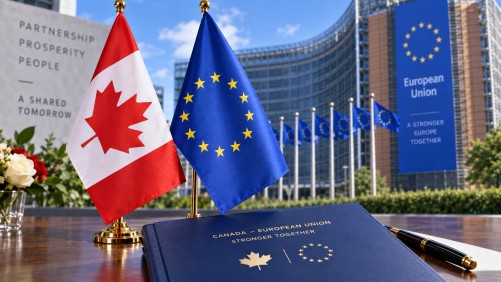
The European Union (EU) has extended an unprecedented invitation to Canada, proposing that it become the bloc’s first-ever “associate member.” This announcement aims to deepen cooperation on various fronts, including economic security and shared prosperity, as highlighted by European Commission President Ursula von der Leyen. The move underscores the shared democratic values and positions on critical global issues between the EU and Canada.
Von der Leyen emphasized the alignment of both parties on significant matters such as artificial intelligence, climate change policy, the ongoing conflict in Ukraine, and global security. The EU-Canada relationship, which already includes a trade agreement and several bilateral arrangements, is poised for expansion into areas like energy, critical minerals, batteries, AI, quantum computing, cybersecurity, and defense.
The proposal for associate membership represents a novel form of partnership, as the EU currently lacks a formal category for such an arrangement. Discussions are anticipated to clarify the details of Canada’s access to EU programs and the single market. The initiative comes at a time when Canada is seeking to diversify its international partnerships, reducing its traditional reliance on the United States.
A summit scheduled for October will provide a platform for both parties to deliberate on the future of their relationship and explore the practicalities of this proposed partnership. Canadian Prime Minister Mark Carney has previously advocated for stronger ties with Europe, aligning with Canada’s strategic objectives amid evolving trade and geopolitical landscapes.
This proposal emerges against a backdrop of shifting trade dynamics and geopolitical tensions, particularly with Washington. As discussions progress, both the EU and Canada are expected to negotiate the operational framework of this pioneering associate membership, which could set a precedent for future international alliances.